The Montenegrin State Energetic Company CGES Falsified Data for EBRD to Obtain €28 Million Loan for Substation in Brezna
CGES received an EBRD 28 million loan based on unreliable documentation

The Montenegrin Transmission System CGES falsified data in the project documentation based on which it received a loan from the European Bank for Reconstruction and Development (EBRD) in the amount of €28 million, intended for the construction of a 400kV substation in the center of the village of Gornja Brezna.
In the project documentation submitted with the loan request, CGES stated that there are no houses or signs of life within a 2 km radius of the substation, although they are well aware that the first houses are only a few hundred meters from the existing—and the much larger planned—substation, and that within that 2 km radius there are between 100 and 200 residential and tourist houses.
This was stated by residents of the village of Gornja Brezna, now organized in the Civic Initiative “Save Brezna.” They added that “considering the fact that the Government of Montenegro, which provided the guarantees for this loan, is an accomplice in this deception of the EBRD, and that the implementation of the international energy hub project in Gornja Brezna would mean the destruction of the entire local community with the stamp of the state, this constitutes an international scandal.”
“The loan agreement with the EBRD was signed on August 1, 2024, with public fanfare, and was signed by the EBRD, CGES, and the Government of Montenegro, which provided the loan guarantee. This is key proof that CGES, knowing that the planned 400kV substation makes any life within 2 km impossible, falsified data in the project documentation to bypass the strict EBRD rules that require multiple levels of engagement with local communities and protection of local populations in supported projects.”
“In our case, the state-owned energy company CGES, with the support of the state, has been consciously and continuously working for years to destroy our village, our lives, and our future. This is being done covertly, in secrecy. By falsifying the data about the population of the area, CGES evaded the obligation on which the EBRD strictly insists: that the local community be included from the earliest phase of project planning. CGES is well aware of how many houses and residents live in Gornja Brezna, as for years they have been sending their people who unlawfully enter our properties and, without our knowledge or consent, cut down our forests under the power lines.
Residents of Gornja Brezna Raise Concerns Over Energy Infrastructure: Alcasar Energy is attempting to forcibly seize our land
Residents of Gornja Brezna: Alcasar Energy Enters Our Property Without Permission and Measures What They Plan to Take
Alcazar Energy Seeks Public Interest Status for Wind Power Grid – Will Montenegrin Villagers Lose Their Land?
For now, it remains unclear how it was possible that the EBRD failed to perform a field verification of the data submitted by CGES, but we hope to receive an answer to that question. We have submitted a request to the EBRD to urgently freeze the approved loan funds and initiate a review of the entire project documentation, with a focus on the project's impact on the local community, and to send an independent international expert commission to Gornja Brezna,” the “Save Brezna” Civic Initiative stated.
CGES included false data in project documentation claiming no life near the planned substation.
They remind that energy hubs of this type are nowhere in the civilized world built in populated areas, especially considering that there are kilometers of uninhabited territory in this part of Montenegro, where such a large energy facility would have minimal harmful impact.
“The residents of Gornja Brezna were never informed of these intentions. No one ever contacted us. No public hearing was ever held. We were completely ignored, as if we do not exist. This kind of treatment of an entire human community is unacceptable in any civilized country. And Montenegro, let us recall, is considered the next EU member state. We ask: Can a country that deliberately and continuously works to destroy a local community be considered part of civilized society?” the Civic Initiative asks.
The residents of Brezna wrote to the President of the State, the Speaker of Parliament, the Prime Minister and ministers: “You must react – a silent genocide of the entire village is being prepared.”
Residents of Brezna at a public hearing: “An energy hub in the heart of the village endangers our lives and our future.”
They add that all their human and civil rights guaranteed by international conventions, laws, and the Constitution of Montenegro have been trampled. The Aarhus Convention was violated, which guarantees public participation from the earliest stage of planning; the EBRD's own rules were violated, which also require multiple levels of involvement of local communities, and emphasize the protection of life, health, and property, and insist on communication and respect for local needs.
How CGES falsified documentation for the EBRD
On the official website of the EBRD, in the “Projects” category, the CGES project for the construction of the 400kV Brezna substation is presented. In the section “Project Summary Document,” the documentation clearly shows that the information regarding social and environmental impact is false. Link: https://www.ebrd.com/home/work-with-us/projects/psd/54749.html#customtab-c6f28c9728-item-c1e43886e6-tab
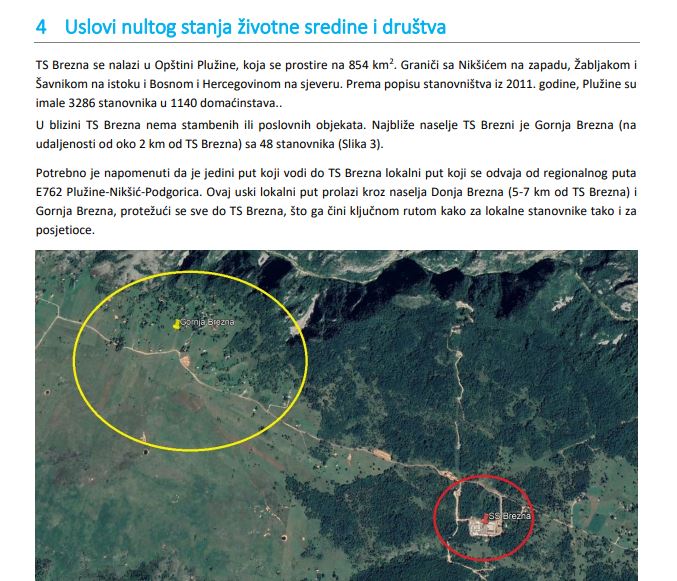
In the document titled “Non-Technical Summary,” under the heading: “Baseline Environmental and Social Conditions,” CGES states, quote:
“There are no residential or commercial buildings in the vicinity of SS Brezna. The nearest settlement to SS Brezna is Gornja Brezna (approximately 2 km from SS Brezna) with 48 residents (Figure 3).”
This is a complete falsehood. The Gornja Brezna substation is planned in the very center of the populated and vibrant village of Gornja Brezna. This village is the most populated and most lively settlement in the municipality of Plužine. People are returning to family properties, and many are buying land and building homes. Some are already engaged in agriculture and tourism, while others are preparing – constructing buildings.
Within a 2 km radius of the Gornja Brezna substation, there are between 100 and 200 houses, either permanently or seasonally inhabited. In the past two years alone, the Municipality of Plužine has issued about 50 urban planning conditions for construction in Gornja Brezna, so it is difficult to state the exact number.
In the section “Summary of environmental and social impacts and mitigation measures,” CGES states, quote:
“It is necessary to purchase several private land plots (adjacent to the existing substation) with a total area of 3.1 hectares. They are owned by several individuals who live abroad.”
— This is not true. The owners of the private plots on which CGES plans to build the substation do not live abroad. One of the owners is Čedo Popović, owner of the company “Carine”, who controversially became the owner of 11 million square meters of municipal land in the municipality of Plužine. Another owner lives in Nikšić, and a court dispute is ongoing between him and CGES regarding the expropriation of his land.
In this document, CGES also states:
“Based on CGES’s previous experiences with similar projects, it is assumed that designating the Project as being of public interest can significantly simplify the land acquisition process. CGES will prepare a Land Acquisition Plan to manage activities under the land acquisition in accordance with national legislation and EBRD requirements.”
CGES has conducted all its activities in the village of Gornja Brezna illegally, non-transparently, and without informing the public. It is obvious that they continue this practice.
The residents of Gornja Brezna were never informed about the plans of the energy companies, nor did they have the opportunity to express their opinion.
They were completely ignored when the private company “Krnovo Green Energy” built the wind farm “Krnovo” and the transmission line and substation in Gornja Brezna. At that time, the state declared public interest for a private company and took land from locals, often with police assistance.
After the project was completed, CGES bought the Brezna substation from the company “Krnovo Green Energy” even though it was extremely poorly constructed, and it is still located on terrain full of underground caves and sinkholes, which are unpredictable and dangerous, and can activate and open at any time, threatening the substation and the entire energy system.
(This is a special and major issue of this project, and given CGES’s methods and record, we have reasonable suspicion that the expert assessment severely underestimates the risks of a catastrophic outcome, especially considering the importance of the planned energy facility.)
The residents of Gornja Brezna: We will defend nature and sustainable development by all means
The residents of Gornja Brezna: Former advisor to Zdravko Krivokapić is building a wind farm in Plužine
Open letter: CGES secretly preparing the displacement of the most beautiful village in Piva — we will not allow it (PHOTO)
Exclusive: Arab “Alcasar Energy” asks the Government to declare public interest for the transmission line of the “Bijela” wind farm; Is property seizure of locals next?
The residents were also completely ignored when CGES was constructing the 400kV transmission line Lastva – Pljevlja. At that time, CGES installed transmission poles without the knowledge or consent of the landowners, and without fair compensation. In many locations across Montenegro — where there were no residents or present landowners — this passed without major issues. When owners later found out, they were faced with a fait accompli. In areas where landowners discovered and resisted, force was used.
It is stated:
Noise and vibration. Construction activities will temporarily increase noise levels, but the impacts will be minor, localized, and limited to daytime morning and afternoon hours. Noise control measures, such as using well-maintained equipment with sound mufflers, will limit noise disturbances beyond 100 m from the site. Construction will generate vibrations from equipment and machinery use. However, due to the absence of nearby structures or sensitive receptors within the range of these vibrations, it is unlikely they will cause disturbances or be noticeable to the local population or affect other sensitive areas.
— This is false. There are indeed nearby buildings, i.e., noise receptors. The first houses are only a few hundred meters from the existing and planned new substation.
During the construction of the existing substation, residents were exposed to constant noise, and the local road was completely destroyed. Afterwards, the locals were forced to block access to the substation in order to pressure the investor to repair the road.
Significant damage during construction was suffered by farmers, livestock owners, and residents involved in tourism.
In the same project documentation based on which CGES received the €28 million EBRD loan, under the section “Traffic”, it is stated:
“The only road leading to the Brezna substation is a local road branching off from the regional road E762 Plužine-Nikšić-Podgorica. This narrow local road passes through the villages of Donja Brezna and Gornja Brezna and extends all the way to the Brezna substation, making it an important route for both local residents and visitors. A slight increase in traffic and temporary road closures during construction activities may lead to traffic congestion on this road, causing inconvenience to the local community and travelers passing through the area. The impact will be short-term and will be managed through a Traffic Management Plan.”
This assessment is based on the initial, key falsehood presented to the EBRD by CGES — that there are no inhabited houses in Gornja Brezna.
This local road is the only access road that the residents of Gornja and Donja Brezna use to connect with the rest of the world. In Donja and Gornja Brezna there are numerous tourist accommodations — wooden cabins and an ethno village, and another ethno village is currently under construction in Gornja Brezna.
Several households have two or three cabins and bungalows for tourists. Locals have invested tremendous effort and resources in recent years to develop sustainable tourism, which is a strategic priority of the state of Montenegro. The state does not help with tourism development, but plans to destroy every opportunity for survival and further growth of eco-tourism by building an international energy hub in the heart of a populated area.
Work and Maintenance Phase
In the section titled “Work and Maintenance Phase”, CGES states:
“The increase in voltage from 110 kV to 400 kV will result in a corresponding rise in noise levels. Since no receptors have been identified nearby, it is not expected that typical noise associated with high-voltage infrastructure will negatively affect the community. The appearance of electromagnetic fields is expected during the operation of high-voltage infrastructure, but represents a low risk in the context of electric substations, considering the rapid decrease in magnetic field intensity with distance.”
— These, like previous claims by CGES in the project documentation submitted to the EBRD, are based on the falsified claim that within a 2 km radius of the planned substation, there are no homes or people.
Given the dense population and close proximity of homes, the expected increase in voltage from 110 kV to 400 kV will likely have an extremely harmful impact on the health and lives of local residents, particularly due to noise and electromagnetic fields. Numerous studies have shown that this type of radiation causes a range of serious health conditions, and that it is especially harmful to children.
The construction of the 400 kV substation and transmission lines in the heart of the village, and the creation of an international energy hub, would mean the end of all economic activity in the area, and all property and prior investments would lose their market value.
“Communications” Section
In the “Communications” section of the documentation, CGES claims:
“A Stakeholder Engagement Plan (SEP) has been developed for this Project, outlining the program of engagement and communication with stakeholders, including access to a project-specific grievance mechanism.”
— We emphasize that the entire Stakeholder Engagement Plan (SEP) is based on the false claim that “within a 2 km radius of the planned substation, there are no buildings or residents,” and that “the village of Gornja Brezna is more than 2 km away and has 48 inhabitants.”
None of the stated activities in that document — neither informing nor involving the local community — were ever carried out. No resident of Gornja Brezna was notified, no public consultation was organized, no one informed the locals about what is planned in the heart of their village, nor were they asked how this would affect their lives, their property, or their future.
The residents of Gornja Brezna learned about all of this by accident about a month ago, when surveyors from the private company Alcasar Energy entered their private property illegally and without permission, without informing or obtaining the consent of landowners, in order to “measure” their land and determine what would be taken for the transmission line of the Bijela Wind Farm project in the municipality of Šavnik.
“That’s when the unraveling began, and we discovered the catastrophic future our own country, Montenegro, had in store for us.”
“We are a local community that works actively on the development of the village, sustainable tourism, livestock farming, and agriculture. Many tourists who visit us leave delighted, and some, unaware of what is being planned, even buy houses here to live — as was recently the case with citizens of the United Kingdom.”
“Our lives, our property, and our future are threatened by the state and state-owned energy companies, as well as by private investors such as Alcasar Energy and Čedo Popović, who plans to cover millions of square meters of pastures and forests in Brezna with solar panels.”
“No civilized country would allow this, let alone lead and coordinate such a process.”
“We are not against energy development. We are only asking that our village not be made an unnecessary sacrifice for that development. We demand that the location of the international energy hub, which is part of the Trans-Balkan Corridor, be relocated to a site where it will not endanger our existence and our sustainable future,” concludes the Citizens’ Initiative “Save Brezna.”