Environmental Protection Agency Illegally Granted Alcazar Energy Partners a “Green Permit”
 Admin
Send an email
26. Februara 2026.
Admin
Send an email
26. Februara 2026.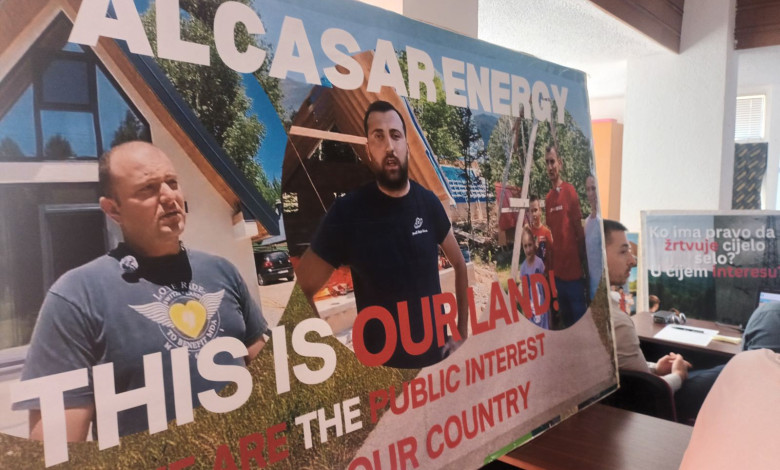
The Environmental Protection Agency (EPA) has signed off on a “green permit” for a project at a location which, according to local residents, is substantially different from the one for which the application was originally submitted—and for which the Agency had previously issued a decision requiring an Environmental Impact Assessment study (elaborate), the civic initiative “Save Brezna” said in a statement.
They claim that this, together with numerous other legal and procedural “acrobatics,” occurred in the case of the EPA’s decision granting consent to the Environmental Impact Assessment Study for the Bijela Wind Power Plant (Šavnik) and an approximately 80-kilometre-long transmission line.
“Given the gravity of the violations of legal and procedural norms in granting the ‘green permit’ for the Bijela Wind Park, we have reasonable grounds to suspect unlawful influence, abuse of office, and other acts that may be subject to criminal prosecution. Therefore, we will also file a criminal complaint with the Special State Prosecutor’s Office (SDT),” the statement reads.
They add that residents of the Piva villages of Brezna (Plužine municipality) and Duži (Šavnik municipality) have filed an appeal against the EPA decision.
“In the appeal, which requests annulment of the consent decision, it is stated that the challenged decision concerns a fundamentally different location from the one for which the Agency, by its Decision No. 03-UPI-2482/7 of 20 December 2024, determined that an assessment study (elaborate) was required, and which was presented at a public hearing in May 2025,” the statement emphasizes.
Alcazar Energy Partners Is Blackmailing Us and Threatening Expropriation
Residents Adopted the Declaration for the Rescue of Brezna: Entry Banned to Corrupt Politicians, Greedy Tycoons, Alcazar Energy and CGES
Alcazar Energy Seeks Public Interest Status for Wind Power Grid – Will Montenegrin Villagers Lose Their Land?
“In the reasoning of its decision, the Agency states that it accepted the request of the investor—Alcazar Energy Partners (Bijela Wind Park)—to change the route in the villages of Duži and Brezna, which, even if that were the only change, would also be unlawful.
A detailed analysis of changes in the project scope, based on a comparative review of the publicly published scope for the public hearing (May 2025), the challenged decision (26 December 2025), and the ‘updated’ study (December 2025), shows that the scope of cadastral parcels has been radically altered across all cadastral municipalities on the originally presented location of the turbines and transmission line—and that two new cadastral municipalities were even added. In the EPA consent decision, at least 142 entirely new cadastral parcels appear that do not exist in the earlier decision requiring the elaborate,” the statement says.
The civic initiative adds that, under the applicable legal framework, the Agency was obliged to conduct a new procedure to decide whether an elaborate was required for such a modified project, to disclose the new scope to the public, and to organize a new public hearing.
Instead, they claim, the Agency attempted to “cover up” the radically modified project location with a single sentence referring to acceptance of “minor changes” at the investor’s request.
The Commission’s Negative Report “Went Missing”
The statement notes that the Impact Assessment Commission, established under Article 21 of the relevant law, on 22 June 2025 prepared an Assessment Report on the elaborate, in which it did not accept the study, while taking into account all objections submitted by residents of Brezna.
However, the Agency, they say, did not inform the residents of Brezna—who had submitted objections—about the Commission’s conclusions, nor did it publish the Commission’s report or the reasons for accepting or rejecting objections, contrary to Articles 22 and 24(5) of the Law on Environmental Impact Assessment.
“One of the objections was that the investor, Alcazar Energy, included numerous private properties along the transmission line route in its elaborate and stated that it had concluded lease agreements with all owners. At that time, not only did it not have lease agreements, but none of the residents even knew anything about the project or that someone had ‘appropriated’ their property,” the statement says.
They add that the elaborate to which the Agency granted consent again includes numerous private parcels that were included without the knowledge or consent of the owners for their property to be part of the documentation.
“In this way, both the elaborate and the decision are based on the false assumption that property-rights relations have been resolved—or can be considered resolved—which is contrary to the law and the obligation to establish real, not hypothetical facts, and to assess the real impacts on property and the population,” the civic initiative said.
“Save Brezna” emphasizes that the appeal is based on numerous actions and omissions by the Agency—in this case by the case officer Milan Vlahović—which they believe are not in compliance with the law, and they expect that a decision founded on multiple violations will be annulled.
They recall that they have been fighting for almost a year to prevent the destruction of their properties and homes by the construction of an international energy hub and multiple transmission lines “drawn” through inhabited areas—across their land, houses, and tourism facilities—according to the wishes and interests of investors.
They also recall that, as they claim, Alcazar Energy Partners, through its Montenegrin company Bijela Wind Park, attempted to conceal the project, the transmission line and its intentions from residents; tried to push public hearings under the radar of the local community; sent surveyors to measure land without owners’ knowledge; and sent emissaries to the most vulnerable residents to persuade and intimidate them with claims that their land would be taken through expropriation if they did not surrender it voluntarily.
In May last year, residents say they discovered that the Montenegrin Electricity Transmission System (CGES), in documentation submitted to the European Bank for Reconstruction and Development (EBRD), presented inaccurate and misleading data about the location and surroundings of the planned energy hub, claiming that there were no houses within a 2-kilometre radius of the planned site. Based on these claims, loan support was approved for a 400 kV substation as the centre of an international energy hub in the middle of a village that lives from tourism and agriculture. An appeals procedure is ongoing before the independent EBRD bodies IPAM and OCCO.
“They must know that we will not allow them to destroy our village, property, lives and future. If they built what they have planned, it would mean a silent genocide and the de facto forced displacement of an entire human community in Brezna. Energy hubs like the one CGES is preparing for us, together with transmission lines of private energy companies which residents perceive as tycoon projects, are built in civilized countries on open seas and completely uninhabited areas—while we will defend our bare survival even with our lives,” the civic initiative “Save Brezna” said.
Admin
Send an email
26. Februara 2026.