ME Government Uses EU Harmonisation as a Cover for Granting Privileges to Energy Investors

The Government of Montenegro is introducing, under the guise of aligning domestic legislation with EU directives, an unconstitutional legal regime that discriminates against Montenegrin citizens, suspends fundamental civil and human rights, seriously threatens public health and the environment, and does so for the benefit of privileged private energy companies.
This was stated in a response issued by the citizens’ initiative Save Brezna and local communities from the Municipality of Šavnik, which argue that this conclusion clearly follows from the proposed amendments to the legislation regulating the construction of renewable energy facilities, including wind farms, solar power plants and small hydropower plants.
Save Brezna Civic Initiative Warns CGES Shareholders: An International Energy Hub in Brezna Will Lead to Disaster
“Public consultations” without citizens: CGES continues to ignore the people living under its transmission lines
Residents of Brezna File Lawsuit Against CGES, Demand Hearing with EBRD Representatives
The communities recall that they have spent more than a year fighting to preserve a valuable area that is attracting increasing numbers of tourists from around the world, while also protecting their homes, property and tourism resources. During that period, they say they have successfully demonstrated through legal action that the planned energy infrastructure in the area was unlawfully planned and is being unlawfully pursued despite the more than obvious fact that it would result in environmental destruction and the forced displacement of local residents.
“Even under the existing laws and regulations, which are themselves far from adequate, we managed to challenge their plans. Now we are witnessing an operation to amend laws and regulations in order to free privileged private investors from any obligations and any responsibility toward people, local communities, nature, the economy and tourism,” the Save Brezna Initiative stated.
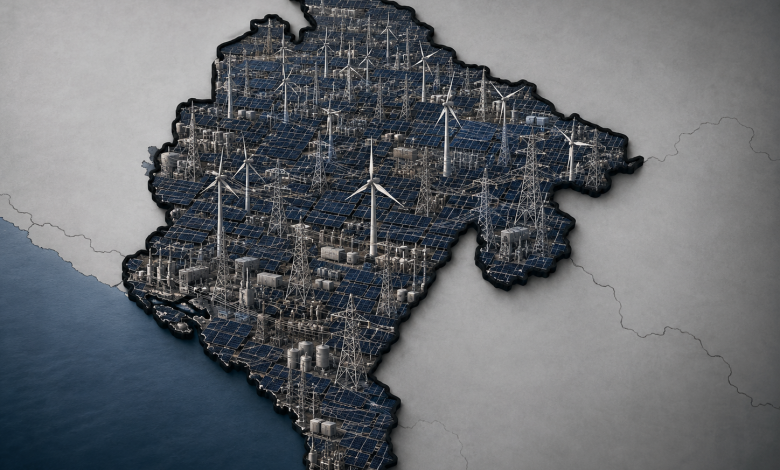
They warn that if the proposed amendments are adopted, energy investors and individuals connected to the system will effectively be able to point to any location in Montenegro they wish to cover with solar panels, wind turbines and transmission lines, or any river they wish to place into pipes, and receive approval to do so.
“It will not matter whether this destroys nature, habitats, people, settlements or local economies. There will be no environmental impact assessment, no public hearings and no effective control mechanism. It is scandalous that the state is attempting to introduce a mechanism allowing it to declare public interest without any meaningful assessment or criteria and to take private property from citizens in order to transfer it to private energy companies that will earn millions from it,” the Initiative stated.
According to the Initiative, the amendments are being presented as part of Montenegro's alignment with Directive (EU) 2023/2413 (RED III).
Because the subject is not familiar to many citizens, they offer a simple explanation.
The Government has proposed amendments to the Law on Renewable Energy Sources that would introduce Article 11e, allowing public interest to be declared for virtually any private energy project and enabling expropriation for the benefit of private capital.
“The proposed amendments create an unconstitutional mechanism for taking and restricting private property rights in favour of private energy projects under a blanket designation of public interest,” the statement says.
The Initiative emphasises that citizens should understand what RED III actually is.
RED III is an EU directive adopted to accelerate the energy transition and increase renewable energy production.
That, they say, is not the problem.
The problem is that RED III:
- does not abolish environmental protection;
- does not abolish public participation in decision-making;
- does not abolish environmental impact assessments;
- does not abolish nature protection;
- does not abolish property rights;
- and does not allow governments to grant private investors a blanket status of “overriding public interest” in advance.
On the contrary, the Initiative argues, the logic of RED III is clear:
Acceleration is allowed only alongside mapping, strategic assessment, public participation and environmental safeguards.
RED III does not authorise governments to hand public-interest status to private projects in advance and override settlements, nature and private property.
Residents of Šavnik and Nikšić: The Government is unlawfully seizing private property in favour of the Arab company Alcazar Energy Partners
Environmental Protection Agency Illegally Granted Alcazar Energy Partners a “Green Permit”
Alcazar Energy Partners Is Blackmailing Us and Threatening Expropriation
The Initiative further points out that Montenegro's own Environmental Impact Assessment Law requires impacts to be assessed in each individual case, including impacts on populations, health, biodiversity, land, water, air, climate, landscape, material assets and accident risks. Similarly, the Strategic Environmental Assessment Law requires energy, spatial-planning and land-use plans to be assessed before adoption, including public participation, alternatives analysis and cumulative-impact assessment.
According to the Initiative:
“The Government of Montenegro is attempting to legalise unconstitutional and unlawful actions through alleged alignment with EU legislation, even though the amendments it proposes are in fact contrary to what EU law requires.”
The communities remind the public that they have repeatedly raised concerns regarding numerous legal irregularities and potentially unlawful conduct associated with the planned international energy hub in the centre of the rural tourism area of Brezna — a concept which, they say, would be unthinkable anywhere in the civilised world.
They state that they first discovered that Montenegro's Transmission System Operator (CGES) had provided false information in project documentation used to obtain a €28 million loan from the European Bank for Reconstruction and Development (EBRD).
Among other things, the documentation reportedly stated that there were no houses within a two-kilometre radius of the planned site, despite the existence of more than 150 homes in that area.
The Initiative further states that CGES publicly labelled local residents as enemies of the state and subjected them to intimidation.
The EBRD's independent accountability mechanism, IPAM, accepted the community's complaint and a compliance process is currently underway to determine whether the Bank itself failed to comply with its own standards. Despite the extensive evidence submitted by the community, project activities continue.
The Initiative also notes that Montenegro's Ministry of Ecology annulled the environmental approval (“green permit”) previously issued by the Environmental Protection Agency for the Bijela Wind Farm, a project developed by UAE-based Alcazar Energy Partners, and returned the matter for reconsideration.
“Now, because that environmental approval cannot be lawfully reissued, parts of the system connected to the investor are changing the laws and exempting current and future developers from the obligation to prepare environmental studies,” the Initiative argues.
The statement further notes that residents of the municipalities of Šavnik and Nikšić have filed an appeal before the competent court challenging the declaration of “public interest” in favour of Alcazar Energy Partners, which would enable the taking of private property from several hundred landowners for the benefit of a private company. The Initiative also points out that amendments to local spatial plans in the municipalities of Plužine and Šavnik designate dozens of new solar and wind power projects on pastures, agricultural land and forest areas.
“We are not against renewable energy. But not at the expense of nature, people, tourism and agriculture. What is currently taking place is an attempt to devastate our most valuable resource — nature — and drive out the few people who remain in northern Montenegro, in the interests of privileged private companies and corrupt individuals within the system.”
The Initiative concludes by expressing hope that the EU Delegation to Montenegro, the European Commission, the Energy Community and EU Member States will intervene to prevent what it describes as the misuse of EU legislation and the destruction of nature, local communities and the de facto forced displacement of people.
“If they fail to do so, we will take every lawful action available to defend the interests of this country and future generations.”